Saturday, May 20, 2017

ISRO to launch 3 satellites in 18 months for high-speed internet-physicsknow

ISRO to launch 3 satellites in 18 months for high-speed internet: GSAT-19 launch in June

The GSAT-19 satellite is scheduled to take off in early June onboard GSLV-Mk III, ISRO's heaviest rocket, from SDSC SHAR, Sriharikota. 

 Space Research Organisation (ISRO)  -physicsknowNew Delhi: The Indian Space Research Organisation (ISRO) will send a series of three communication satellites - GSAT-19, GSAT-11 and GSAT-20 – into the orbit in the next 18 months to increase internet speed across the nation, as per a report in Indian Express.


The GSAT satellites are India's indigenously developed technologies of communications satellites, with an objective to make the country self-reliant in broadcasting services.
The GSAT-19 satellite is scheduled to take off in early June onboard GSLV-Mk III, ISRO's heaviest rocket, from SDSC SHAR, Sriharikota.
This would be the maiden flight for GSLV-Mk III, the next generation launch vehicle of ISRO capable of launching 4 ton class of satellites to Geosynchronous Transfer orbit (GTO).
“The next big launch will be GSAT-19 in June. With this launch, we will begin a new age of communication satellites. It is also the beginning of high-throughput satellites (in India),” Tapan Misra, director of Ahmedabad-based Space Applications Centre (SAC), an arm of ISRO that develops satellite payloads, was quoted as saying by the Indian Express.
“While the world is already witnessing a change in the communication technology where voice and video communications are taking place through Internet, with future launches, television will be viewed through Internet using wireless Technology,” Misra added.
These launches will not only revolutionise the way we use televisions and smart-phones, but will also drive the future communication needs of smart cities, the report added.
ISRO said the satellite will carry Ka-band and Ku-band payload along with a Geostationary Radiation Spectrometer (GRASP) payload to monitor and study the nature of the charged particles and influence of space radiation on spacecraft and electronic components.
GSAT-19 satellite will employ advanced spacecraft technologies including bus subsystem, indigenous Li ion battery, indigenous Bus bars for power distribution, etc, the Indian space agency added.
Earlier this month on the 5th May, ISRO successfully launched the Geostationary communication satellite-9 (GSAT-9) – India's gift to South Asia - into a Geostationary orbit.
The GSAT-9 is meant for providing communication and disaster support and connectivity among the countries of South Asia region, with the mission life of about 12 years.

physicsknow facebook page

PHYSICSKNOW facebook page 

like and share our page for more.

https://m.facebook.com/physicsknow/

Friday, May 19, 2017

NASA probes detect man-made bubble around Earth-physicsknow


The impact of such communications extend out beyond our atmosphere, creating a bubble surrounding Earth, NASA`s Van Allen Probes, which study electrons and ions in the near-Earth environment, have revealed. 

Washington: Humans have long been shaping Earth`s landscape, but now scientists know that we also can shape our near-space environment with radio communications.
The impact of such communications extend out beyond our atmosphere, creating a bubble surrounding Earth, NASA`s Van Allen Probes, which study electrons and ions in the near-Earth environment, have revealed. 
A certain type of communications -- very low frequency, or VLF, radio communications -- were found to interact with particles in space, affecting how and where they move. 
At times, these interactions can create a barrier around Earth against natural high energy particle radiation in space, showed the results of a study published in the journal Space Science Reviews.
"A number of experiments and observations have figured out that, under the right conditions, radio communications signals in the VLF frequency range can in fact affect the properties of the high-energy radiation environment around the Earth," said Phil Erickson, Assistant Director at the Massachusetts Institute of Technology (MIT) Haystack Observatory, Westford, Massachusetts.
VLF signals are transmitted from ground stations at huge powers to communicate with submarines deep in the ocean. 
While these waves are intended for communications below the surface, they also extend out beyond our atmosphere, shrouding Earth in a VLF bubble. 
This bubble is even seen by spacecraft high above Earth`s surface, such as NASA`s Van Allen Probes.
The probes noticed an interesting coincidence ? the outward extent of the VLF bubble corresponds almost exactly to the inner edge of the Van Allen radiation belts, a layer of charged particles held in place by Earth`s magnetic fields. 
With further study, VLF transmissions may serve as a way to remove excess radiation from the near-Earth environment. 
Plans are already underway to test VLF transmissions in the upper atmosphere to see if they could remove excess charged particles ? which can appear during periods of intense space weather, such as when the sun erupts with giant clouds of particles and energy, NASA said.

Wednesday, May 17, 2017

physicsknow - Earth 2.0 has water, supports alien life?

Earth 2.0 has water, supports alien life?

Proxima B was discovered last August

An ‘Earth-like’ planet orbiting our closest neighbouring star, Proxima Centauri, about 4.2 light years away may have water and the potential to support alien life, a new study has found.
The planet Proxima B was discovered in August last year, and is thought to be of similar size to Earth, creating the possibility that it could have an ‘Earth-like’ atmosphere.
Scientists from the University of Exeter in the U.K. have embarked on their first, tentative steps to explore the potential climate of the exoplanet.
Early studies have suggested that the planet is in the habitable zone of its star Proxima Centauri — the region where, given an Earth-like atmosphere and suitable structure, it would receive the right amount of light to sustain liquid water on its surface.
Now, experts have undertaken new research to explore the potential climate of the planet, towards the longer term goal of revealing whether it has the potential to support life.
Researchers simulated the climate of Proxima B if it were to have a similar atmospheric composition to our own Earth.
The team also explored a much simpler atmosphere, comprising of nitrogen with traces of carbon dioxide, as well as variations of the planets orbit. This allowed them to both compare with, and extend beyond, previous studies.
However, much more work must be done to truly understand whether this planet can support, or indeed does support life of some form, researchers said.
“Our research team looked at a number of different scenarios for the planet’s likely orbital configuration using a set of simulations,” said Ian Boutle, lead author of the study published in the journal Astronomy and Astrophysics.
“One of the main features that distinguishes this planet from Earth is that the light from its star is mostly in the near infra-red,” said James Manners, from University of Exeter.

Sunday, May 14, 2017

physicsknow - Mark Elliot Zuckerberg computer programmer who was co founder and CEO of Facebook

Mark Zuckerberg -physicsknow
Born May 14, 1984

Mark Elliot Zuckerberg computer programmer who was cofounder and CEO of Facebook, a social networking Web site.

After attending Phillips Exeter Academy, Zuckerberg enrolled at Harvard University in 2002. On February 4, 2004, he launched thefacebook.com(renamed Facebook in 2005), a directory in which fellow Harvard students entered their own information and photos into a template that he had devised. Within two weeks half of the student body had signed up. Zuckerberg’s roommates, Dustin Moskovitz and Chris Hughes, helped him add features and make the site available to other campuses across the country. Facebook quickly became popular as registered users could create profiles, upload photos and other media, and keep in touch with friends. It differed from other social networking sites, however, in its emphasis on real names (and e-mail addresses), or “trusted connections.” It also laid particular emphasis on networking, with information disseminated not only to each individual’s network of friends but also to friends of friends—what Zuckerberg called the “social graph.”
In the summer of 2004 the trio moved their headquarters to Palo Alto, California, where Zuckerberg talked venture capitalist Peter Thiel into giving them seed money. Zuckerberg dropped out of Harvard to concentrate on the fledgling company, of which he became CEO and president. In May 2005 Facebook received its first major infusion of venture capital ($12.7 million). Four months later Facebook opened to registration by high-school students. Meanwhile, foreign colleges and universities also began to sign up, and by September 2006 anyone with an e-mail address could join a regional network based on where he or she lived. About that time Zuckerberg turned down a $1 billion buyout offer from Yahoo!, but in 2007 Facebook struck a deal with Microsoft in which the software company paid $240 million for a 1.6 percent stake in Facebook; two years later Digital Sky Technologies purchased a 1.96 percent share for $200 million. In 2008 Zuckerberg’s new worth was estimated at about $1.5 billion. After Facebook’s initial public offering (IPO) of stock in 2012, Zuckerberg’s net worth was estimated at more than $19 billion. In April 2017 his net worth is 59.4 billion. Now monthly Facebook has 1 billion active users.
Nevertheless, Zuckerberg has remained true to his initial vision – to create a website that the entire world can use to communicate openly and easily with one another. Hes turned down opportunities to sell the site, often for multi-billion dollar sums. Hes even turned down chances to increase the sites income from ad revenue, instead preferring to keep the user experience clean and pure.The end result is one of the worlds biggest online businesses, and an icon of the tech renaissance thats occurred recently.Although its true value is debatable, its safe to say that Facebook, and its creator Mark Zuckerberg, are two of the twenty-first centurys most influential, controversial, and potentially powerful figures.

Monday, March 27, 2017

the father of X-Rays and diagnostic radiology!-physicsknow

Image may contain: 1 person, text

Who was the first person ever to receive the Nobel Prize in Physics? Wilhelm Röntgen, the father of X-Rays and diagnostic radiology! He was born #onthisday in 1845.

physicsknow 


Röntgen left his mark on science in a variety of areas, from understanding the behaviour of gases at different temperatures to the compressibility of water. But one of his most famous scientific contributions is the discovery of X-rays.

X-rays are a type of radiation. They have a range of uses, but they are most commonly known for their role in helping doctors see inside of patients’ bodies. Doctors use them to create medical scan images of different body parts, such as broken bones. This helps them diagnose diseases and rule out medical problems safely and rapidly without having to make an incision. You can learn more about X-rays here:

This Month In Physics History-physicsknow

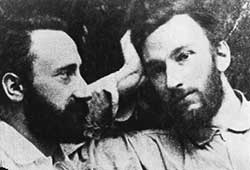
The Curie Brothers Discover Piezoelectricity  March 1880:physicsknow


Microphones, quartz watches, and inkjet printers all rely on an unusual phenomenon known as the piezoelectric effect found in various crystals, ceramics, and even bone. It was discovered by none other than French physicist Pierre Curie, working with his older brother Jacq
Pierre and Jacque
Brothers and colleagues: Jacques (left) and Pierre (right) Curie, discoverers of the piezoelectric effect.
ues, who found that putting pressure on these materials created electricity (the name comes from piezein — Greek for “squeeze”).
Born in Paris in 1859 to a physician named Eugene Curie, Pierre’s early education was decidedly unorthodox: his father opted for private tutors for his son, believing it to be the best approach given the boy’s temperament and keen intellect. Pierre showed an early aptitude for mathematics, and at 16 entered the Sorbonne for his university studies. He successfully earned the equivalent of a master’s degree by 18, but was forced to postpone his doctoral studies. During this time, he earned a meager living as a lab instructor.
Pierre started conducting chemistry experiments at the age of 20 with Jacques, focusing on the structure of crystals. They were especially interested in the pyroelectric effect, in which a change in temperature in a crystalline material generates an electric potential. This effect had been known since the mid-18th century, thanks to the work of Carl Linnaeus and Franz Aepinus, and subsequent scientists had hypothesized that there could be a relationship between the properties of mechanical stress and electrical potential. But experimental confirmation proved elusive.
The brothers Curie thought there would be a direct correlation between the potential generated by temperature changes and the mechanical strain that gave rise to piezoelectricity. They expected that a piezoelectric effect would arise in materials with certain crystal asymmetries. Armed with the crudest of materials — tinfoil, glue, wire, magnets, and a simple jeweler’s saw — they tested various types of crystals, including quartz, topaz, cane sugar, Rochelle salt, and tourmaline. As a result, the Curies found that when such materials were compressed, the mechanical strain did indeed result in an electric potential. The strongest piezeoelectric effects were found in quartz and Rochelle salt. The brothers put their discovery immediately to good use by inventing the piezoelectric quartz electrometer.
There was a twist to the piezoelectric saga still to come. The following year, mathematician Gabriel Lippman demonstrated that there should be a converse piezoelectric effect, whereby applying an electric field to a crystal should cause that material to deform in response. The brothers rushed to test Lippman’s theory, and their experiments showed the mathematician was correct. Piezoelectricity could indeed work in the other direction.
After the initial flurry of excitement died down, piezoelectric research faded into the background for the next 30 years or so, in part because the theory was so mathematically complex. But incremental progress was still being made. In 1910, Woldemar Voigt published the definitive treatise on the subject, Lehrbuch der Kristallphysik, a massive tome describing the 20-odd classes of natural crystal with piezoelectric properties. More importantly, it rigorously defined the 18 possible macroscopic piezoelectric coefficients in crystal solids.
This set the stage for subsequent development of practical applications for such materials, beginning with sonar in 1917, when Paul Langevin developed an ultrasonic transducer for use on submarines using thin quartz crystals. Many automobiles today have ultrasonic transducers to assist drivers in measuring the distance between the rear bumper and any obstacles in its path.
Pierre moved on to investigating magnetism, uncovering an intriguing effect of temperature on paramagnetism now known as Curie’s law. Another discovery was the Curie point: the critical temperature at which ferromagnetic materials cease to be ferromagnetic. He even flirted with paranormal spiritualism as the 19th century drew to a close, attending séances with famed medium Eusapia Palladino, approaching them as a scientific experiment with detailed observational notes, in hopes that such study would shed light on magnetism. “I must admit that those spiritual phenomena intensely interest me,” he wrote to his fiancée, Marie Sklodowska, in 1894. “I think in them are questions that deal with physics.”
Pierre married Marie the following year, when he also finally completed his doctorate, thanks to her encouraging him to use his magnetism work as a doctoral thesis. He became a professor of physics and chemistry at Paris in 1895. (Jacques became a professor of mineralogy at the University of Montpellier.) His new wife replaced his brother as his scientific partner. The two discovered radium (and later, polonium), sharing the 1903 Nobel Prize in Physics with Henri Becquerel. The piezoelectric quartz electrometer invented by Pierre and Jacques all those years before proved an essential instrument in their ongoing work.
Towards the end of his life, Pierre showed early signs of over-exposure to radium. In fact, his clothes were often so radioactive he had to postpone experiments by several hours because it interfered with his instruments. The unit of radioactivity is called the curie in his and Marie’s honor. But he was spared a gruesome death by radiation sickness. Instead, he was killed in a freak accident, run down by a wagon on the Place Dauphine as he was crossing the busy street.
Marie always felt Pierre did not get the respect and support he deserved from his scientific colleagues. He did not engage in academic politics, preferring to focus on his research. He was rejected for a professorship in mineralogy and denied membership in the French Academy in 1903, the same year he won the Nobel Prize. His early work on piezoelectricity was not, perhaps, his most significant discovery over his illustrious career, but as he observed in an 1894 letter to Marie: “[In science] we can aspire to accomplish something…. every discovery, however small, is a permanent gain.”