Monday, March 27, 2017

the father of X-Rays and diagnostic radiology!-physicsknow

Image may contain: 1 person, text

Who was the first person ever to receive the Nobel Prize in Physics? Wilhelm Röntgen, the father of X-Rays and diagnostic radiology! He was born #onthisday in 1845.

physicsknow 


Röntgen left his mark on science in a variety of areas, from understanding the behaviour of gases at different temperatures to the compressibility of water. But one of his most famous scientific contributions is the discovery of X-rays.

X-rays are a type of radiation. They have a range of uses, but they are most commonly known for their role in helping doctors see inside of patients’ bodies. Doctors use them to create medical scan images of different body parts, such as broken bones. This helps them diagnose diseases and rule out medical problems safely and rapidly without having to make an incision. You can learn more about X-rays here:

This Month In Physics History-physicsknow

The Curie Brothers Discover Piezoelectricity  March 1880:physicsknow


Microphones, quartz watches, and inkjet printers all rely on an unusual phenomenon known as the piezoelectric effect found in various crystals, ceramics, and even bone. It was discovered by none other than French physicist Pierre Curie, working with his older brother Jacq
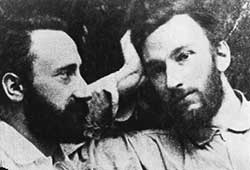
Pierre and Jacque
Brothers and colleagues: Jacques (left) and Pierre (right) Curie, discoverers of the piezoelectric effect.
ues, who found that putting pressure on these materials created electricity (the name comes from piezein — Greek for “squeeze”).
Born in Paris in 1859 to a physician named Eugene Curie, Pierre’s early education was decidedly unorthodox: his father opted for private tutors for his son, believing it to be the best approach given the boy’s temperament and keen intellect. Pierre showed an early aptitude for mathematics, and at 16 entered the Sorbonne for his university studies. He successfully earned the equivalent of a master’s degree by 18, but was forced to postpone his doctoral studies. During this time, he earned a meager living as a lab instructor.
Pierre started conducting chemistry experiments at the age of 20 with Jacques, focusing on the structure of crystals. They were especially interested in the pyroelectric effect, in which a change in temperature in a crystalline material generates an electric potential. This effect had been known since the mid-18th century, thanks to the work of Carl Linnaeus and Franz Aepinus, and subsequent scientists had hypothesized that there could be a relationship between the properties of mechanical stress and electrical potential. But experimental confirmation proved elusive.
The brothers Curie thought there would be a direct correlation between the potential generated by temperature changes and the mechanical strain that gave rise to piezoelectricity. They expected that a piezoelectric effect would arise in materials with certain crystal asymmetries. Armed with the crudest of materials — tinfoil, glue, wire, magnets, and a simple jeweler’s saw — they tested various types of crystals, including quartz, topaz, cane sugar, Rochelle salt, and tourmaline. As a result, the Curies found that when such materials were compressed, the mechanical strain did indeed result in an electric potential. The strongest piezeoelectric effects were found in quartz and Rochelle salt. The brothers put their discovery immediately to good use by inventing the piezoelectric quartz electrometer.
There was a twist to the piezoelectric saga still to come. The following year, mathematician Gabriel Lippman demonstrated that there should be a converse piezoelectric effect, whereby applying an electric field to a crystal should cause that material to deform in response. The brothers rushed to test Lippman’s theory, and their experiments showed the mathematician was correct. Piezoelectricity could indeed work in the other direction.
After the initial flurry of excitement died down, piezoelectric research faded into the background for the next 30 years or so, in part because the theory was so mathematically complex. But incremental progress was still being made. In 1910, Woldemar Voigt published the definitive treatise on the subject, Lehrbuch der Kristallphysik, a massive tome describing the 20-odd classes of natural crystal with piezoelectric properties. More importantly, it rigorously defined the 18 possible macroscopic piezoelectric coefficients in crystal solids.
This set the stage for subsequent development of practical applications for such materials, beginning with sonar in 1917, when Paul Langevin developed an ultrasonic transducer for use on submarines using thin quartz crystals. Many automobiles today have ultrasonic transducers to assist drivers in measuring the distance between the rear bumper and any obstacles in its path.
Pierre moved on to investigating magnetism, uncovering an intriguing effect of temperature on paramagnetism now known as Curie’s law. Another discovery was the Curie point: the critical temperature at which ferromagnetic materials cease to be ferromagnetic. He even flirted with paranormal spiritualism as the 19th century drew to a close, attending séances with famed medium Eusapia Palladino, approaching them as a scientific experiment with detailed observational notes, in hopes that such study would shed light on magnetism. “I must admit that those spiritual phenomena intensely interest me,” he wrote to his fiancée, Marie Sklodowska, in 1894. “I think in them are questions that deal with physics.”
Pierre married Marie the following year, when he also finally completed his doctorate, thanks to her encouraging him to use his magnetism work as a doctoral thesis. He became a professor of physics and chemistry at Paris in 1895. (Jacques became a professor of mineralogy at the University of Montpellier.) His new wife replaced his brother as his scientific partner. The two discovered radium (and later, polonium), sharing the 1903 Nobel Prize in Physics with Henri Becquerel. The piezoelectric quartz electrometer invented by Pierre and Jacques all those years before proved an essential instrument in their ongoing work.
Towards the end of his life, Pierre showed early signs of over-exposure to radium. In fact, his clothes were often so radioactive he had to postpone experiments by several hours because it interfered with his instruments. The unit of radioactivity is called the curie in his and Marie’s honor. But he was spared a gruesome death by radiation sickness. Instead, he was killed in a freak accident, run down by a wagon on the Place Dauphine as he was crossing the busy street.
Marie always felt Pierre did not get the respect and support he deserved from his scientific colleagues. He did not engage in academic politics, preferring to focus on his research. He was rejected for a professorship in mineralogy and denied membership in the French Academy in 1903, the same year he won the Nobel Prize. His early work on piezoelectricity was not, perhaps, his most significant discovery over his illustrious career, but as he observed in an 1894 letter to Marie: “[In science] we can aspire to accomplish something…. every discovery, however small, is a permanent gain.”

Wednesday, March 22, 2017

Bihar Diwas: Did You Know Its Origins Lie In The Raj Era?-physicsknow

On 22 March, the 105th Bihar Diwas will be observed, setting the stage for three-day-long celebrations in the state. A string of events, including performances by Bollywood personalities, and announcement of big-ticket government initiatives will mark the occasion. But why is Bihar Diwas celebrated and which event does it commemorate? The answer lies in history, in the dying days of the British Raj.

22 March 1912

The coronation of King George V in Delhi took place in 1911. It was decided that the capital of British India was shifting to Delhi. The new governor of Bengal Thomas-Gibson Carmichael, who took charge on 21 March 1912, wasted no time in announcing the next day that the Bengal Presidency will, from then on, be split into the four subhas of Bengal, Orissa, Bihar and Assam. Thomas -Gibson Carmichael (Photo Courtesy: Wikipedia)
Thomas -Gibson Carmichael .

Why Were They Clubbed Together Earlier?

The Battle of Buxar was fought on 22 October 1764 between the forces under the command of the British East India Company led by Hector Munro, and the combined army of Mir Qasim, the Nawab of Bengal; the Nawab of Awadh; and the Mughal King Shah Alam II. The battle fought at Buxar, a "small fortified town" within the territory of Bengal, located on the bank of the Ganges about 130 km west of Patna, was a decisive victory for the British East India Company. Date: 22 October 1764; Location: Near Buxar. The Commanders and leaders are: Shuja-ud-Daula, Mirza Najaf Khan, Shah Alam II, Mir Qasim, Hector Munro of Novar. (Photo Courtesy: CSEINDIAPORTAL)
Date: 22 October 1764; Location: Near Buxar. The Commanders and leaders are: Shuja-ud-Daula, Mirza Najaf Khan, Shah Alam II, Mir Qasim, Hector Munro of Novar.

Diwani Rights Go to East India Company

After the Battle of Buxar in 1764, which was fought in Buxar, hardly 115 km from Patna, the Mughals as well as the Nawabs of Bengal lost effective control over the territories, then constituting the province of Bengal, which currently comprises Bangladesh, and the Indian states of West Bengal, Bihar, Jharkhand, Odisha. East India Company was accorded the diwani rights, that is, the right to administer the collection and management of revenues of the province of Bengal. India’s political map in 1765, the year the decisive battle of Buxar was fought. (Photo Courtesy: Wikipedia)
India’s political map in 1765, the year the decisive battle of Buxar was fought.
Nitish Kumar’s Brainchild: Bihar Diwas From 2010
When Nitish Kumar took charge as the chief minister of Bihar, he was looking for a commemorative event in Bihar’s history that could become the state’s official day of celebration. The fact that Bihar had been carved out from Bengal Presidency on 22 March 1912, was now the birthday of Bihar. Ever since then, the day is celebrated across the state as Bihar Diwas. Numerous state functions and children’s activities are held on this day. We wish Bihar a Happy Bihar Diwas.


Tuesday, March 21, 2017

physicsknow- E=MC^2

41e88190a1f0c65deee38633de1ac630

This Month in Physics History-physics know

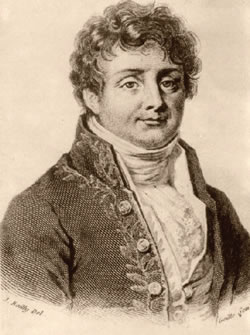
Birth of Jean-Baptiste Joseph Fourier

fourier web March 21, 1768

physicsknow


 The human ear splits incoming sound waves into their component frequencies through mechanical means by exploiting natural resonances: namely, different nerve endings in our ears are sensitive to different frequencies. But it is also possible to analyze a sound mathematically to determine its component frequencies. This can be done thanks to a method, devised by an 18th century French mathematician named Jean-Baptiste Joseph Fourier, known as a Fourier transform.

Born on March 21, 1768, Fourier was the son of a tailor in the village of Auxerre. Orphaned by age 10, the young Joseph received an early rudimentary education at a local convent, thanks to a recommendation by the local bishop, and he proved such an apt pupil he went on to study at the École Royale Militaire of Auxerre. There he fell in love with mathematics. By 1790 Fourier was teaching at his alma mater.

Revolution was brewing in France. Fourier was sympathetic at first to the cause, drawn by “the natural ideas of equality,” and a hope “of establishing among us a free government exempt from kings and priests.” He joined his local Revolutionary Committee, but soon regretted it, as the ultra-violent Reign of Terror gripped France and thousands of nobles and intellectuals fell victim to the guillotine.

Fourier made the mistake of defending the stance of his own Auxerre faction before a rival sect while on a trip to Orléans. In July 1794, he was arrested and imprisoned for the views he’d expressed on that trip, and found himself facing the guillotine. But with the death of Maximilien Robespierre, the Revolution lost steam and Fourier and his fellow prisoners were freed. Fourier was selected for a new teacher-training school to help rebuild France, where he studied under three of the most prominent French mathematicians: Joseph-Louis Lagrange, Pierre-Simon Laplace, and Gaspard Monge. By September 1795, Fourier was teaching at the prestigious École Polytechnique.

A few years after his academic appointment, he joined Napoleon’s army as a scientific advisor when Napoleon invaded Egypt, engaging in archaeological expeditions and helping found the Cairo Institute as Napoleon’s military fortunes waxed and waned. By 1801, Fourier was back in France, teaching, until Napoleon appointed him prefect in Grenoble. He promptly stirred up a mathematical controversy with his conclusions about his experiments on the propagation of heat.

The culprit was an equation describing how heat traveled through certain materials as a wave. He based his reasoning in part on Newton’s law of cooling: the flow of heat between two adjacent molecules is proportional to the difference of their temperatures. Fourier concluded that every wave-like “signal,” no matter how complex, can be represented by adding together many different waves. In other words, complicated periodic functions–whether continuous or discontinuous–can be expanded and written out as simple waves mathematically represented by sines and cosines.

Fourier completed his memoir, On the Propagation of Heat in Solid Bodies, in 1807 and read it to the Paris Institute on December 21 of that year. The reception was mixed. Both Lagrange and Laplace objected to the notion of what we now call Fourier series: the expansions of functions as trigonometrical series. Along with another scientist, Jean-Baptiste Biot, they also objected to Fourier’s derivation of the equations of transfer of heat. (Biot had written an earlier paper on the topic in 1804, although that paper proved incorrect.)

Nonetheless, when the Paris Institute held a competition on the topic of how heat propagates in solid bodies in 1811, Fourier submitted his memoir for consideration. He won the prize, in part because only one other entry was received. The selection committee (which included Lagrange and Laplace) recorded their reservations in their report: “The manner in which the author arrives at these equations is not exempt of difficulties and… his analysis to integrate them still leaves something to be desired on the score of generality and even rigor.”

Because of the controversy, Fourier’s memoir was not published until 1822, after his election to the Académie des Sciences in 1817, and the same year he became the Académie’s secretary. His work did contain flaws, but it also provided the basis for later work on trigonometric series and the theory of functions of a real variable, most notably the Fourier transform, an operation that turns one function of a real variable into another. It is widely used in digital signal processing, as well as in the physical study of wave motion and optics.

Fourier’s other claim to fame is the discovery in 1824 of the “greenhouse effect”: namely, that certain gases in Earth’s atmosphere could trap heat from the sun instead of having it radiate back into space, thereby increasing the surface temperature of Earth. He was inspired by an earlier experiment with so-called “hot boxes” by Horace-Bénédict de Saussure, in which a wooden box lined with black cork was exposed to sunlight. De Saussure then inserted three small panes of glass into the cork, and noted that the temperature rose in those compartments closer to the center of the box.

However, de Saussure did not have a solid theory for this observed effect. Fourier rightly surmised that Earth gains energy from numerous sources, most notably solar radiation causing an increase in temperature, and that Earth also radiates energy via infrared radiation (which he called chaleur obscure, or “dark heat”), and that a balance must be maintained between heat gain and heat loss. He incorrectly assumed that a significant amount of radiation from interplanetary space contributed to the greenhouse effect, but grasped that the rate of infrared radiation increased with Earth’s temperature. This latter insight was mathematically defined 50 years later with the Stefan-Boltzmann law, further refined by Planck’s law 20 years after that.

Fourier continued to publish papers on mathematics until his death in 1830, when he tripped and fell down the stairs at home. His tomb is in the Père Lachaise Cemetery in Paris, decorated with an Egyptian motif in honor of his position as secretary of the Cairo Institute.

Thursday, February 23, 2017

NASA Telescope Reveals Record-Breaking Exoplanet Discovery


Tuesday, February 14, 2017

William Shockley | phyiscsknow

The Bell Laboratories engineer shared the 1956 Nobel Prize in Physics with John Bardeen and Walter Brattain for the development of the transist


William Shockley
or, which sparked the modern age of electronics.Born on 13 February 1910 in London, William Shockley was an engineer who shared the 1956 Nobel Prize in Physics with John Bardeen and Walter Brattain for the development of the transistor. He earned a PhD from MIT in 1936 and began doing solid-state physics work at Bell Laboratories in Murray Hill, New Jersey. After conducting research for the Navy during World War II, he rejoined Bell and investigated the use of semiconductors as an alternative to vacuum tubes for amplifying and channeling electronic signals. In 1947, Shockley, Bardeen, and Brattain invented the point-contact transistor; the following year they created the junction transistor. The three scientists’ work ushered in the modern era of electronics. Shockley later wrote a book and became a professor at Stanford University. In the years following his Nobel, Shockley was known more for his ignorant views on race—he maintained that black people are genetically inferior to white people—than his physics achievements. He died in Palo Alto, California, in 1989.