Wednesday, March 22, 2017

Bihar Diwas: Did You Know Its Origins Lie In The Raj Era?-physicsknow

On 22 March, the 105th Bihar Diwas will be observed, setting the stage for three-day-long celebrations in the state. A string of events, including performances by Bollywood personalities, and announcement of big-ticket government initiatives will mark the occasion. But why is Bihar Diwas celebrated and which event does it commemorate? The answer lies in history, in the dying days of the British Raj.

22 March 1912

The coronation of King George V in Delhi took place in 1911. It was decided that the capital of British India was shifting to Delhi. The new governor of Bengal Thomas-Gibson Carmichael, who took charge on 21 March 1912, wasted no time in announcing the next day that the Bengal Presidency will, from then on, be split into the four subhas of Bengal, Orissa, Bihar and Assam. Thomas -Gibson Carmichael (Photo Courtesy: Wikipedia)
Thomas -Gibson Carmichael .

Why Were They Clubbed Together Earlier?

The Battle of Buxar was fought on 22 October 1764 between the forces under the command of the British East India Company led by Hector Munro, and the combined army of Mir Qasim, the Nawab of Bengal; the Nawab of Awadh; and the Mughal King Shah Alam II. The battle fought at Buxar, a "small fortified town" within the territory of Bengal, located on the bank of the Ganges about 130 km west of Patna, was a decisive victory for the British East India Company. Date: 22 October 1764; Location: Near Buxar. The Commanders and leaders are: Shuja-ud-Daula, Mirza Najaf Khan, Shah Alam II, Mir Qasim, Hector Munro of Novar. (Photo Courtesy: CSEINDIAPORTAL)
Date: 22 October 1764; Location: Near Buxar. The Commanders and leaders are: Shuja-ud-Daula, Mirza Najaf Khan, Shah Alam II, Mir Qasim, Hector Munro of Novar.

Diwani Rights Go to East India Company

After the Battle of Buxar in 1764, which was fought in Buxar, hardly 115 km from Patna, the Mughals as well as the Nawabs of Bengal lost effective control over the territories, then constituting the province of Bengal, which currently comprises Bangladesh, and the Indian states of West Bengal, Bihar, Jharkhand, Odisha. East India Company was accorded the diwani rights, that is, the right to administer the collection and management of revenues of the province of Bengal. India’s political map in 1765, the year the decisive battle of Buxar was fought. (Photo Courtesy: Wikipedia)
India’s political map in 1765, the year the decisive battle of Buxar was fought.
Nitish Kumar’s Brainchild: Bihar Diwas From 2010
When Nitish Kumar took charge as the chief minister of Bihar, he was looking for a commemorative event in Bihar’s history that could become the state’s official day of celebration. The fact that Bihar had been carved out from Bengal Presidency on 22 March 1912, was now the birthday of Bihar. Ever since then, the day is celebrated across the state as Bihar Diwas. Numerous state functions and children’s activities are held on this day. We wish Bihar a Happy Bihar Diwas.


Tuesday, March 21, 2017

physicsknow- E=MC^2

41e88190a1f0c65deee38633de1ac630

This Month in Physics History-physics know

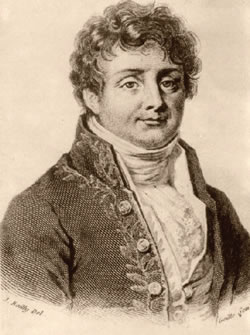
Birth of Jean-Baptiste Joseph Fourier

fourier web March 21, 1768

physicsknow


 The human ear splits incoming sound waves into their component frequencies through mechanical means by exploiting natural resonances: namely, different nerve endings in our ears are sensitive to different frequencies. But it is also possible to analyze a sound mathematically to determine its component frequencies. This can be done thanks to a method, devised by an 18th century French mathematician named Jean-Baptiste Joseph Fourier, known as a Fourier transform.

Born on March 21, 1768, Fourier was the son of a tailor in the village of Auxerre. Orphaned by age 10, the young Joseph received an early rudimentary education at a local convent, thanks to a recommendation by the local bishop, and he proved such an apt pupil he went on to study at the École Royale Militaire of Auxerre. There he fell in love with mathematics. By 1790 Fourier was teaching at his alma mater.

Revolution was brewing in France. Fourier was sympathetic at first to the cause, drawn by “the natural ideas of equality,” and a hope “of establishing among us a free government exempt from kings and priests.” He joined his local Revolutionary Committee, but soon regretted it, as the ultra-violent Reign of Terror gripped France and thousands of nobles and intellectuals fell victim to the guillotine.

Fourier made the mistake of defending the stance of his own Auxerre faction before a rival sect while on a trip to Orléans. In July 1794, he was arrested and imprisoned for the views he’d expressed on that trip, and found himself facing the guillotine. But with the death of Maximilien Robespierre, the Revolution lost steam and Fourier and his fellow prisoners were freed. Fourier was selected for a new teacher-training school to help rebuild France, where he studied under three of the most prominent French mathematicians: Joseph-Louis Lagrange, Pierre-Simon Laplace, and Gaspard Monge. By September 1795, Fourier was teaching at the prestigious École Polytechnique.

A few years after his academic appointment, he joined Napoleon’s army as a scientific advisor when Napoleon invaded Egypt, engaging in archaeological expeditions and helping found the Cairo Institute as Napoleon’s military fortunes waxed and waned. By 1801, Fourier was back in France, teaching, until Napoleon appointed him prefect in Grenoble. He promptly stirred up a mathematical controversy with his conclusions about his experiments on the propagation of heat.

The culprit was an equation describing how heat traveled through certain materials as a wave. He based his reasoning in part on Newton’s law of cooling: the flow of heat between two adjacent molecules is proportional to the difference of their temperatures. Fourier concluded that every wave-like “signal,” no matter how complex, can be represented by adding together many different waves. In other words, complicated periodic functions–whether continuous or discontinuous–can be expanded and written out as simple waves mathematically represented by sines and cosines.

Fourier completed his memoir, On the Propagation of Heat in Solid Bodies, in 1807 and read it to the Paris Institute on December 21 of that year. The reception was mixed. Both Lagrange and Laplace objected to the notion of what we now call Fourier series: the expansions of functions as trigonometrical series. Along with another scientist, Jean-Baptiste Biot, they also objected to Fourier’s derivation of the equations of transfer of heat. (Biot had written an earlier paper on the topic in 1804, although that paper proved incorrect.)

Nonetheless, when the Paris Institute held a competition on the topic of how heat propagates in solid bodies in 1811, Fourier submitted his memoir for consideration. He won the prize, in part because only one other entry was received. The selection committee (which included Lagrange and Laplace) recorded their reservations in their report: “The manner in which the author arrives at these equations is not exempt of difficulties and… his analysis to integrate them still leaves something to be desired on the score of generality and even rigor.”

Because of the controversy, Fourier’s memoir was not published until 1822, after his election to the Académie des Sciences in 1817, and the same year he became the Académie’s secretary. His work did contain flaws, but it also provided the basis for later work on trigonometric series and the theory of functions of a real variable, most notably the Fourier transform, an operation that turns one function of a real variable into another. It is widely used in digital signal processing, as well as in the physical study of wave motion and optics.

Fourier’s other claim to fame is the discovery in 1824 of the “greenhouse effect”: namely, that certain gases in Earth’s atmosphere could trap heat from the sun instead of having it radiate back into space, thereby increasing the surface temperature of Earth. He was inspired by an earlier experiment with so-called “hot boxes” by Horace-Bénédict de Saussure, in which a wooden box lined with black cork was exposed to sunlight. De Saussure then inserted three small panes of glass into the cork, and noted that the temperature rose in those compartments closer to the center of the box.

However, de Saussure did not have a solid theory for this observed effect. Fourier rightly surmised that Earth gains energy from numerous sources, most notably solar radiation causing an increase in temperature, and that Earth also radiates energy via infrared radiation (which he called chaleur obscure, or “dark heat”), and that a balance must be maintained between heat gain and heat loss. He incorrectly assumed that a significant amount of radiation from interplanetary space contributed to the greenhouse effect, but grasped that the rate of infrared radiation increased with Earth’s temperature. This latter insight was mathematically defined 50 years later with the Stefan-Boltzmann law, further refined by Planck’s law 20 years after that.

Fourier continued to publish papers on mathematics until his death in 1830, when he tripped and fell down the stairs at home. His tomb is in the Père Lachaise Cemetery in Paris, decorated with an Egyptian motif in honor of his position as secretary of the Cairo Institute.

Thursday, February 23, 2017

NASA Telescope Reveals Record-Breaking Exoplanet Discovery


Tuesday, February 14, 2017

William Shockley | phyiscsknow

The Bell Laboratories engineer shared the 1956 Nobel Prize in Physics with John Bardeen and Walter Brattain for the development of the transist


William Shockley
or, which sparked the modern age of electronics.Born on 13 February 1910 in London, William Shockley was an engineer who shared the 1956 Nobel Prize in Physics with John Bardeen and Walter Brattain for the development of the transistor. He earned a PhD from MIT in 1936 and began doing solid-state physics work at Bell Laboratories in Murray Hill, New Jersey. After conducting research for the Navy during World War II, he rejoined Bell and investigated the use of semiconductors as an alternative to vacuum tubes for amplifying and channeling electronic signals. In 1947, Shockley, Bardeen, and Brattain invented the point-contact transistor; the following year they created the junction transistor. The three scientists’ work ushered in the modern era of electronics. Shockley later wrote a book and became a professor at Stanford University. In the years following his Nobel, Shockley was known more for his ignorant views on race—he maintained that black people are genetically inferior to white people—than his physics achievements. He died in Palo Alto, California, in 1989.

Friday, February 3, 2017

Today is the birthday of physicist Paul Scherrer-physics know

Paul Scherrer
Today is the birthday of physicist Paul Scherrer, who was born in St. Gallen, Switzerland, in 1890. He enrolled at ETH Zurich intending to study botany but switched to mathematics and physics; in 1916 he earned a PhD from the University of Göttingen in Germany. During his graduate studies Scherrer codiscovered a technique for analyzing the structure of crystals with x rays. Scherrer became a professor at ETH Zurich and organized the first international physics conference to be held after World War I. He helped make ETH one of the leading physics institutions by building three particle accelerators and focusing on experimental nuclear physics. Following World War II Scherrer was named president of the Swiss Study Commission on Atomic Energy and the Swiss Commission for Atomic Sciences. He was instrumental in attracting CERN to set up its headquarters in Geneva. And his lectures were legendary, wrote Hans Frauenfelder and Rolf Steffen in their Physics Today obituary of Scherrer: “Rockets flew through the lecture room, crystals changed their colors, and living cats proved their knowledge of angular-momentum conservation.” Today the Paul Scherrer Institute is the largest research facility for natural and engineering sciences in Switzerland.

Tuesday, January 31, 2017

physics know-This Month in Physics History-Physics and the Boston Molasses Flood-January 15,


All told, the flood killed 21 people (along with several horses) and injured 150 others. Rescue efforts were undertaken by several cadets from the USS Nantucket, which was docked at a local pier, as well as police officers, the Red Cross, and Army and Navy personnel in the area. Survivors were taken to a makeshift hospital, although the rescuers struggled to reach victims in time because of the difficulty of wading through the molasses. It took weeks to clean up the mess, using salt water to wash the stuff away and sand to absorb any remaining behind. Even so, people had tracked molasses through adjacent streets, subways, pay phones, streetcars, even into their homes.
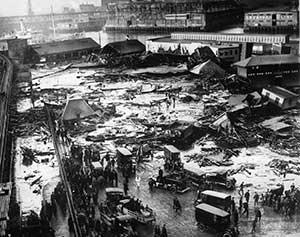
Boston molasses disaster
One of the strangest historical tragedies of 20th century America is the Great Boston Molasses Flood of 1919, when tons of treacle from a burst storage tank coursed through the city’s streets. The incident reveals some fascinating fluid dynamics, according to a presentation at the annual meeting of the APS Division of Fluid Dynamics in November 2016.
The owner of the faulty tank was the Purity Distilling Company. At that time, molasses was a vital commodity, not just because it could be fermented to make rum and ethanol, but also for its use in making munitions as World War I raged in Europe. Located in the North End of Boston, the tank was built hastily because of the war, with rather loose regard for safety regulations. Most notably, it was never filled to capacity to test for leakage, prior to being used to store molasses. Not surprisingly, the tank leaked from the start, showing brownish-red stains in stark contrast to the original blue paint job. Some people even collected the leaked molasses for their personal use. When a few local residents finally complained, the company painted the tank to match the stains, in order to camouflage the leaks.
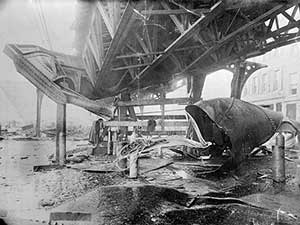
Boston molasses train disasterIn hindsight, a catastrophic failure was inevitable, and disaster struck on the afternoon of January 15, 1919. Witnesses heard a roar, a rumbling sound, and then a crash and a loud bang. The the tank — which had just been filled to near capacity a few days before — had collapsed under the strain, and 8.7 million liters of molasses rushed into the streets of Boston, peaking in height at 27 meters and flowing as fast as 56 kilometers per hour.
The onslaught was sufficiently powerful to flatten several buildings and do significant damage to the girders of the nearby elevated train. People caught in the flow struggled waist-deep in the molasses, and contemporary newspaper accounts describe people being picked up and hurled several feet, crushed by and drowned in molasses. Others succumbed to injuries and infections in the subsequent weeks.
Boston residents sued Purity Distilling’s parent company, the United States Industrial Alcohol Company, which initially claimed that the flood had occurred because anarchists had blown up the tank as an act of terror. This initially seemed plausible, given how fast the molasses spread through the streets. But investigators concluded this was baseless. In the end, the courts found the company responsible, with survivors of the victims receiving roughly $7,000 each as compensation for their loss. And two decades later, physicists discovered that gravity acting on the viscous fluid provided sufficient driving force to account for the speed of the molasses.
Several factors contributed to the bursting of the tank. Some hypothesized that the fermentation process caused carbon dioxide to build up inside the tank, until its rivets burst. Alternatively, a 2014 structural engineering analysis by Ronald Mayville found that steel used to make the tank was half as thick as it should have been, given its size, and also was far more brittle than modern steel because of the absence of manganese. Furthermore, the rivet holes were not reinforced, making them more likely to deteriorate under stress.
Yet nobody had really studied the fluid dynamics of how the molasses behaved during the flood until aerospace-engineer-turned-science-communicator Nicole Sharp teamed up last year with Harvard graduate students Jordan Kennedy and Shmuel Rubinstein to conduct rheological studies of the substance and model the resulting data. Then they compared the models’ predictions with historical accounts of the actual flood. And those predictions matched reasonably well with the details Sharp et al. gleaned from the archives.
By doing so, they gained some insight into highly viscous spreading flows. Molasses typically falls into the category of a shear-thinning non-Newtonian fluid, but Sharp et al. decided to use classical fluid models for their study because at sufficiently cold temperatures — like those on that fateful January day in Boston — it behaves more like a classical fluid. In other words, temperature has more of an effect on the viscosity of molasses at very cold temperatures than deformation. Additional research should shed light on likely convective mixing between warm and cold molasses inside the storage tank just prior to the structural failure, which may have also contributed to the accident.
Sharp believes that understanding the physics of the Great Molasses Flood could provide insight onto other structural failures, such as breached levees or industrial spills. But the flood is also a useful interdisciplinary educational tool, incorporating fluid dynamics, structural mechanics, and engineering, in addition to history, ethics, and law. "We hope that, by shedding some light on the physics of a fascinating and surreal historical event, we can inspire a greater appreciation for fluid dynamics among out students and the public," said Sharp.