Monday, January 16, 2017

Water, Water Everywhere-physicsknow

16114117_10154995901372139_3391072171240651519_n

The palm tree-fringed beaches of the Maldives give the appearance of an island paradise. But behind the tiny island nation lies a more complicated story.

The archipelago numbers 1,190 coral islands grouped into 26 atolls. Tourism powers the country’s economy, as 80 of its islands contain resorts. But its most lucrative asset—proximity to the azure seas—threatens to bring its downfall. The Maldives stands to lose much to sea-level rise, according to the United Nations.

As the smallest Asian country, the Republic of Maldives has a total population the size of a modest European city. The islands rise just a smidgeon above the Indian Ocean: roughly 80 percent of the country stands no more than 1 meter (3 feet) above sea level, according to the CIA World Factbook.

The nation was one of the first to warn of the effects of climate change that are already taking place. In 2009, then-president Mohamed Nasheed made international headlines by holding an underwater cabinet meeting in scuba attire to draw attention to the issue.

During bad storms, knee-deep water has inundated some islands. MalĂ©, the capital and home to one-third of the nation’s residents—as well as multi-million dollar concrete stormwalls—has borne the brunt of several large storms in the past few decades. The city has also struggled to contain vector-borne diseases like dengue fever. (Heavy rains leave behind shallow pools where disease-spreading mosquitoes lay their eggs.)

This image was acquired on April 3, 2013, by the Advanced Spaceborne Emission and Reflection Radiometer (ASTER) aboard the Terra satellite. Note: the synthetic natural color image, which combines several different spectral ranges to simulate the look of natural color, makes the islands appear slightly brighter than would an aerial photograph.

Martin Luther King Jr.-physicsknow

16105791_1376975449014216_8377148626990948285_n

Martin Luther King Jr.
Born on January 15, 1929

Martin Luther King Jr. was a Baptist minister and social activist, who led the Civil Rights Movement in the United States from the mid-1950s until his death by assassination in 1968.
Martin Luther King Jr. was born on January 15, 1929, in Atlanta, Georgia. King, both a Baptist minister and civil-rights activist, had a seismic impact on race relations in the United States, beginning in the mid-1950s. Among many efforts, King headed the SCLC. Through his activism, he played a pivotal role in ending the legal segregation of African-American citizens in the South and other areas of the nation, as well as the creation of the Civil Rights Act of 1964 and the Voting Rights Act of 1965. King received the Nobel Peace Prize in 1964, among several other honors. King was assassinated in April 1968, and continues to be remembered as one of the most lauded African-American leaders in history, often referenced by his 1963 speech, "I Have a Dream."


know more about physics in physicsknow

Sunday, January 15, 2017

science of the week -Illuminating biology-physicsknow

Illuminating biology
Martin Chalfie, heard about the green fluorescent protein for the first time in 1988 at a seminar. During the seminar, Chalfie realised that green fluorescent protein would be a fantastic tool for mapping the roundworm C. elegans. It would act as a glowing green signal for various activities in the roundworm’s cells.
Chalfie succeeded in introducing the gene for GFP into the DNA of the small, almost transparent worm C. elegans. GFP was produced by the cells, giving off its green glow without the need for the addition of any extra components, and without any indication of causing damage to the worms. Subsequent work showed that it was possible to fuse the gene for GFP to genes for other proteins, opening-up a world of possibilities for tracking the localization of specific proteins in living organisms.
The strong green colour of this protein appears under blue and ultraviolet light. It can, for example, illuminate growing cancer tumours; show the development of Alzheimer’s disease in the brain or the growth of pathogenic bacteria.
Warm congratulations to Martin Chalfie, today 70!
Photo: Crystal jelly (Aequorea victoria) taken in the Monterey Bay Aquarium, CA, USA. Author Mnolf,

The Day We Discovered the Universe- physicsknow

Andromeda nebula, photographed at the Yerkes Observatory circa 1900. To modern eyes, this is clearly a galaxy. At the time, though, it was described as "a mass of glowing gas." (From the book Astronomy of To-Day)
What’s in a date? Strictly speaking, New Year’s Day is just an arbitrary flip of the calendar, but it can also be a cathartic time of reflection and renewal. So it is with one of the most extraordinary dates in the history of science, January 1, 1925. You could describe it as a day when nothing remarkable happened, just the routine reading of a paper at a scientific conference. Or you could recognize it as the birthday of modern cosmology–the moment when humankind discovered the universe as it truly is.
Until then, astronomers had a myopic and blinkered view of reality. As happens so often to even the most brilliant minds, they could see great things but they could not comprehend what they were looking at. The crucial piece of evidence was staring them right in the face. All across the sky, observers had documented intriguing spiral nebulae, swirls of light that resembled ghostly pinwheels in space. The most famous one, the Andromeda nebula, was so prominent that it was easily visible to the naked eye on a dark night. The significance of those ubiquitous objects was a mystery, however.

Some researchers speculated that the spiral nebulae were huge and distant systems of stars, “island universes” comparable to our Milky Way galaxy. But many others were equally convinced that the spirals were small, nearby clouds of gas. In this view, other galaxies–if they existed–were far out of sight, blue whales lurking in the far depths of the cosmos. Or perhaps there were no other galaxies at all, and our Milky Way was all there was: a single system that defined the entire universe. The dispute between the two sides was so intense that it prompted a famous 1920 Great Debate…which ended with an unsatisfying draw.
The correct picture of our place in the universe arrived just a few years later through the work of one of the most famous names in astronomy: Edwin Powell Hubble (no relation!). Starting in 1919, Hubble had established himself as one of the most patient and meticulous observers at Mount Wilson Observatory in California.  Mt Wilson, in turn, had just established itself as the premier outpost for astronomical research, home of the just-completed 100-inch Hooker Telescope—then the biggest in the world. It was the perfect combination of the right observer in the right place at the right time.
Always cautious when it came to theory and interpretation, Hubble focused his scientific attention on the spiral nebulae without overtly endorsing the “island universe” interpretation. He preferred to wait until he could be the one to step forward with definitive proof–or disproof, if that’s where the evidence pointed.
In 1922, another important piece of the puzzle fell into place. That year, Swedish astronomer Knut Lundmark observed what he believed were individual stars in the arms of the spiral nebula M33. Shortly after, John Duncan at Mount Wilson spotted dots of light that grew fainter and brighter in the same nebula. Could these be variable stars, similar to ones in the Milky Way but far dimmer owing to their enormous distance?
Sensing the answer was at hand, Hubble stepped up his efforts. He spent long nights on his favorite bentwood chair, guiding the movements of the riveted-steel mount of the Hooker telescope to cancel out Earth’s rotation. The effort paid off with highly detailed, long-exposure images of the Andromeda nebula. The mottled light of the nebula began to resolve itself into a multitude of luminous points, looking not like a smear of gas but like a vast hive of stars.
Clinching proof came in October of 1923, when Hubble spied the telltale flicker of a lone Cepheid variable star in one of Andromeda’s arms. This type of star grows brighter and dimmer in a regular and predictable way, with its intrinsic luminosity directly related to its period of variation. Simply by timing the 31-day cycle of this star as it slowly flickered, Hubble could deduce its distance. His estimate was 930,000 light years–less than half the modern estimate, but a shockingly large number at the time. That distance placed Andromeda, one of the brightest and presumably closest of the spiral nebulae, vastly outside the bounds of the Milky Way.
In principle, the Great Debate was settled then and there. Spiral nebulae were other galaxies, and our Milky Way was just one outpost within a staggeringly vast universe. And yet, still the story was far from over.
Edwin Hubble at the controls of the 100-inch telescope at Mount Wilson, circa 1922. (Credit: Huntington Library)

Friday, January 13, 2017

Rakesh Sharma, the first Indian in space physicsknow

Rakesh Sharma, AC, Hero of the Soviet Union, (born 13 January 1949) is a former Indian Air Force pilot who flew aboard Soyuz T-11, launched April 2, 1984, as part of the Intercosmos programme. Sharma was the first Indian to travel in space.
 "Saare Jahan Se Accha", said RakeshSharma on being asked how India looks from space.
Today is the birthday of the first Indian to travel in space.

Thursday, January 12, 2017

This Month in Physics History- physicsknow

This Month in Physics History-physicsknow

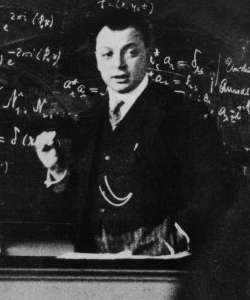
January 1925: Wolfgang Pauli announces the exclusion principle

The year 1925 was an important one for quantum physics, beginning with Wolfgang Pauli’s January announcement of the exclusion principle. This well-known principle, which states that no two identical fermion particles can be in the same quantum state, provided for the first time a theoretical basis for the structure of the periodic table of the elements.
Pauli's exclusion principle
Wolfgang Pauli

Wolfgang Pauli was born in Vienna in 1900, the same year that quantum mechanics itself was born with Planck’s announcement of the idea of the energy quanta. Pauli’s father was a physician and chemistry professor at the University of Vienna, and his godfather was Ernest Mach. As a young prodigy, when he found himself bored during class, Pauli would read Einstein’s papers on relativity. By age 20 Pauli, then a student of Arnold Sommerfeld at the University of Munich, had published papers on relativity and written an encyclopedia article on relativity which greatly impressed other physicists, including Albert Einstein himself. Having learned classical mechanics and relativity, Pauli was disconcerted by quantum mechanics upon being introduced to it by Sommerfeld, and at first he found the subject rather confused.

Possibly because of his brilliance, Pauli’s professors and colleagues tolerated some of his more annoying habits, such as his custom of sleeping extremely late and rarely showing up for lectures before noon. He was also extremely critical, and famous for deriding his colleagues’ less-than-coherent work as “not even wrong.” His tendency to criticize often spurred others to clarify their ideas. Pauli also had such an amazing propensity to cause accidents that scientists began to believe that even to have him come close to one’s lab meant doom for the experiment.

After receiving his doctorate in 1921 and spending some time in Gottingen and then Copenhagen, Pauli took a position at the University of Hamburg in 1923. He gave his first lecture there on the periodic table of elements, which he found unsatisfactory because the atomic shell structure was not understood. In 1913, Bohr had proposed that electrons could occupy only certain quantized orbitals, but there seemed to be no reason why all the electrons in an atom didn’t simply crowd into the one lowest energy state. There was no convincing explanation of the structure of the periodic table. Pauli had also recently worked on trying to explain the anomalous Zeeman effect, (a consequence of electron spin) and was convinced that the two problems were somehow related.

In late 1924, Pauli made a big leap by suggesting the idea of a adding a fourth quantum number to the three that were then used to describe an electron’s quantum state. The first three quantum numbers made sense physically, since they related to the electron’s motion around the nucleus. Pauli called his new quantum property of the electron a “two-valuedness not describable classically.” Soon after making this proposal, Pauli realized that it could lead to the solution of the problem of the closed orbitals.

Then in January 1925, he announced the exclusion principle, stating that no two electrons in an atom can occupy a state with the same values for the four quantum numbers. Each electron had to be in its own unique state. Other possibilities are excluded.

Pauli’s proposed fourth quantum number puzzled physicists at the time, because no one could explain its physical significance. Pauli himself was troubled by the idea. Pauli was also bothered by the fact that he couldn’t give any logical explanation for the exclusion principle or derive it from other laws of quantum mechanics, and he remained unhappy about this problem. Nonetheless, the principle worked–it explained the structure of the periodic table and is essential for explaining other properties of matter.

Later in 1925, Samuel Goudsmit and George Uhlenbeck, inspired by Pauli’s work, interpreted the fourth quantum number as the electron’s spin. Pauli originally applied the exclusion principle to explain electrons in atoms, but later it was extended to any system of fermions, which have half integer spin, but not to bosons, which have integer spin.

In the two years after Pauli’s announcement of his exclusion principle, the new quantum mechanics took off, with Heisenberg’s formulation of matrix mechanics, and Schrödinger’s wave mechanics, which was based on de Broglie’s idea that matter can have wavelike properties.

In 1928 Pauli moved to Zurich. He spent time during World War II in the United States, and returned to Zurich after the war. In 1931, Pauli proposed the existence of a new particle, the neutrino, as a solution to the apparent lack of energy conservation in beta decay. After his many research accomplishments, he spent much of his later years thinking about the history and philosophy of science.

Pauli always insisted on having a clear and coherent explanation of a phenomenon, and always strove to find both an intuitive understanding of an experiment and a rigorous mathematical scheme. Max Born once commented that, “I knew he was a genius, comparable only to Einstein himself. But he was a completely different type of man, who in my eyes, did not attain Einstein’s greatness.” In 1945, Pauli was awarded the Nobel Prize for the discovery of the exclusion principle. He died in 1958.

Thursday, January 5, 2017

The Birth of Quantum Mechanics

Max Planck presents the first paper on quantum mechanics, to the German Physical Society on 14 December 1900. Quantum Mechanics is the science dealing with how matter and light behave on the atomic and subatomic scale.
The development of quantum physics is regarded by many as the finest intellectual edifice of the 20th century. This position was not reached in a single step but rather during three main periods:
1. Max Planck's work on the 'Black Body' problem started the quantum revolution in 1900. He showed that energy cannot take any value but is arranged in discrete lumps – later called photons by Einstein.
2. In 1913, Niels Bohr proposed a model of the atom with quantised electron orbits. Although a great step forward, quantum physics was still in its infancy and was not yet a consistent theory. It was more like a collection of classical theories with quantum ideas applied.
3. Starting in 1925 a true 'quantum mechanics' – a set of mathematically and conceptual 'tools' – was born. At first, three different incantations of the same theory were proposed independently and were then shown to be consistent. Quantum mechanics reached its final form (essentially unchanged from today) in 1928.
Max Planck's paper Zur Theorie des Gesetzes der Energieverteilung im Normalspektrum (On the Theory of the Law of Energy Distribution in Normal Spectrum)