Tuesday, February 20, 2018

This Month in Physics History- physicsknow February 11


This Month in Physics History- physicsknow

February 11, 1738: Jacques de Vaucanson Exhibits Flute-playing Automaton

n 18th century Europe, intricate mechanical creatures were all the rage among nobles and commoners alike. The undisputed master of lifelike automatons was a French inventor named Jacques de Vaucanson, whom Voltaire dubbed a "new Prometheus."
Vaucanson was born in Grenoble, France, in 1709, the tenth child of a glove maker. Raised in poverty, the young Jacques showed an early interest in mechanical objects, and he was fascinated by the church clock whenever he accompanied his Catholic mother to confession. He built his own version of the clock at home. When his father died, the seven-year-old boy was sent to a monastery for schooling; he brought along a metal box filled with his parts and tools, the better to build a model boat. It interfered with his studies, but his math teacher was sufficiently impressed with the boy’s drawings that he decided to help his student with the project.
Given his financial situation, Vaucanson decided a life in the clergy would give him the freedom to pursue his scientific interests on the side. So he became a novice in the Order of the Minims in Lyon, where he found a patron in a local nobleman and set up a workshop. When the head of the order came to visit, Vaucanson’s sense of whimsy led him to build some rudimentary automata to serve dinner and clear the tables after the meal. The effort backfired: the visitor denounced the inventor’s mechanical bent as "profane," and forced him to shut down his workshop.
A disappointed Vaucanson abandoned his plan to become a monk and withdrew from the order, running away to Paris instead, where historians believe he took classes in anatomy and medicine at the Jardines du Roi. He definitely found another patron to finance his dream of building lifelike automata. During an illness, he dreamed of a flute-playing automaton, which inspired him to design a real-life version, hiring local clockmakers and craftsmen to fabricate the intricate parts.
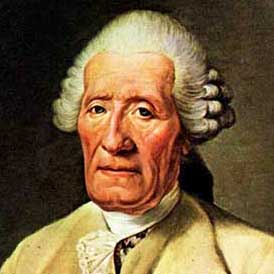
Jacques de Vaucanson
wikimedia commons
Jacques de Vaucanson
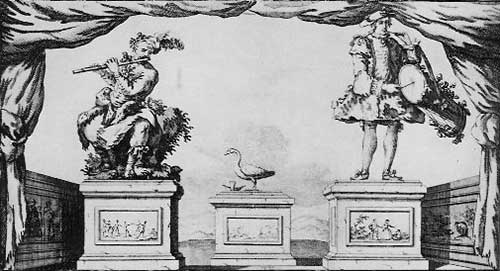
Mechanical musicians and a duck
wikimedia commons
Mechanical musicians and a defecating duck
He unveiled his flute-playing creation at a public exhibition on February 11, 1738, and it was a huge success, drawing regular crowds for over a year. The wooden figure was painted white, the better to resemble a sculpture’s marble, with a corresponding mechanism for every tiny muscle involved in the task. Thanks to an intricate set of pipes and bellows, the automaton could "breathe," and the mouth had a movable tongue, the better to control airflow through the flute. After struggling with motion of the wooden fingers, he wound up covering them in a soft glove-like skin. The automaton could play 12 different melodies.
His success brought an invitation to present his automaton to the French Academy of Sciences the following year. The academy judged the machine "extremely ingenious," and praised "both the intelligence of the creator and his extensive knowledge of mechanical parts." However, court musician and flautist Johannes Joachim Quanta found the playing shrill, probably due to the limited motion of the robot’s mechanical lips. As audiences grew bored with his flute player, Vaucanson built a second automaton, a tambourine player with a repertoire of 20 tunes.
But the inventor’s masterpiece was a gold-plated, life-sized Defecating Duck automaton that could quack, rise up on its legs, and boasted what Vaucanson claimed was a functioning digestive system—perhaps inspired by its inventor’s own lifelong struggles with digestive ailments. The duck would swallow grain and a "chemical factory" in the stomach would decompose the food, excreting the waste in front of a live audience. Decades later, a magician named Jean-Eugene Robert-Houdin—who built his own automaton—discovered that Vaucanson had tricked his audiences with a clever artifice: the digestion wasn’t real. The waste was actually pre-stored bread crumbs dyed green to look like digested grain.
The mechanical duck was a smashing success, and Vaucanson would up touring Europe with his creations. Voltaire memorably observed in 1741 that "without the voice of le Maure and Vaucanson’s duck, you would have nothing to remind you of the glory of France." It was also immortalized in Thomas Pynchon’s novel Mason and Dixon, in which the duck attains consciousness and chases a chef across the United States. Alas, the infamous duck is believed to have been destroyed when the museum in which it was purportedly housed burned down in 1879.
Eventually Vaucanson grew bored with his automata and sold them off to a trio of businessmen. King Louis XV had just appointed him inspector of silk manufacture, in hopes of making the silk industry in France competitive with its rivals in England and Scotland. Far ahead of his time, in 1745 he invented the first automated loom, and hoped to introduce punch cards to the industry. But the weavers revolted, fearing for their jobs, and pelted him with stones as he walked through the streets. Vaucanson retaliated by building a loom powered by a donkey, declaring that "a horse, an ox or an ass can make cloth more beautiful than the most able silk worker."
This did not go over well. The king came to his inspector’s defense and cracked down on the weavers, forbidding them from public meetings, issuing fines, and imprisoning some of them. Yet they persisted in their protests, and the king relented after a year. Fifty years later, Joseph-Marie Jacquard would succeed where Vaucanson failed with an automated loom.
Vaucanson died in Paris in 1782. His vision of an automaton capable of reproducing digestive functions was finally realized in 2006, when a Belgian conceptual artist named Wim Delvoye unveiled his "Cloaca Machine," a mechanical and chemical apparatus that really did digest food and turn it into waste, carefully vacuum-sealed in specially branded bags and sold to eager art collectors.

Wednesday, December 6, 2017

CONNECT WITH US BY SOCIAL MEDIA OF PHYSICSKNOW 

LIKE OUR PAGE ON FACEBOOK  https://www.facebook.com/physicsknow/
FOLLOW US ON INSTAGRAM https://www.instagram.com/physicsknow/
AND TWITTER  https://twitter.com/physicsknow
ALSO ON YOUTUBE  https://www.youtube.com/channel/UCuR3z7Pv5KAadU9OCdbj9Fg/featured
#physicsknow @physicsknow physicsknow

Friday, December 1, 2017

How scientists and supercomputers could make oceans drinkable- physics know

Aleksandr Noy

Senior Research Scientist,

Lawrence Livermore National Laboratory

Removing salt from seawater is an enormous challenge. Researchers may have the answer – but it will require a whole lot of processing power.


ALEKSANDR NOY HAS big plans for a very small tool. A senior research scientist at Lawrence Livermore National Laboratory, Noy has devoted a significant part of his career to perfecting the liquid alchemy known as desalination – removing salt from seawater. His stock-in-trade is the carbon nanotube. In 2006, Noy had the audacity to embrace a radical theory: maybe nanotubes – cylinders so tiny, that they can be seen only with an electron microscope – could act as desalination filters. It depended on just how wide the tubes were. The opening needed to be big enough to let water molecules flow through but small enough to block the larger salt particles that make seawater undrinkable. Put enough carbon nanotubes together and you potentially have the world’s most efficient machine for making clean water

Thursday, October 5, 2017

The Nobel Prize in Physics 2017-physicsknow

Nobel Prize in Physics 2017

Gravitational wave researchers win Nobel Prize

Rainer Weiss (left) from MIT, Barry Barish from Caltech, and Kip Thorn from Caltech all shared the 2017 Nobel Prize in Physics.

Three American physicists have won the 2017 Nobel Prize in Physics for their contribution to detecting gravitational waves. 

The Nobel Prize in Physics 2017 was divided, one half awarded to Rainer Weiss, the other half jointly to Barry C. Barish and Kip S. Thorne "for decisive contributions to the LIGO detector and the observation of gravitational waves".

Thursday, September 7, 2017

physics is in our everyday life |PhysicsKnow|

physics is in our everyday life |PhysicsKnow|


Sunday, September 3, 2017

This Month in Physics History- September 1905 -PhysicsKnow

September 1905: Einstein's Most Famous Formula

Einstein

 Einstein's Most Famous Formula-

   physicsknow

Although several renowned scientists published papers bearing on the theory of special relativity prior to 1900 - including Maxwell, Lorentz and Henri Poincaré - 1905 is generally recognized as the birth year of special relativity. That year saw publication of two important papers on the subject, by an obscure patent clerk named Albert Einstein.
Having failed to obtain a university post teaching mathematics and physics, Einstein was working in the patent office in Bern, Switzerland, when he completed an astonishing range of theoretical physics publications, all written in his spare time with
out the benefit of close contact with scientific literature or colleagues.
In June, 1905, Einstein proposed what we know today as the special theory of relativity. He based his theory on a reinterpretation of the classical principle of relativity, which postulates that the laws of physics must have the same form in any frame of reference. The theory also assumed that the speed of light remained constant in all frames of reference, as required by Maxwell's theory.
But it was later that year, in a paper received by the Annalen der Physik on September 27, applying his equations to study the motion of a body, that Einstein showed that mass and energy were equivalent, a startling new insight he expressed in a simple formula that became synonymous with his name: E=mc2. However, full confirmation of his theory was slow in coming. It was not until 1933, in Paris, when Irène and Frédéric Joliot-Curie took a photograph showing the conversion of energy into mass, in which a quantum of light carries energy up from beneath and converts into mass in the middle, creating two particles which curve away from each other.

Monday, August 28, 2017

NASA say-Large Asteroid to Safely Pass Earth on Sept. 1 2017 - physicsknow

Large Asteroid to Safely Pass Earth on Sept. 1


Asteroid Florence, a large near-Earth asteroid, will pass safely by Earth on Sept. 1, 2017, at a distance of about 4.4 million miles, (7.0 million kilometers, or about 18 Earth-Moon distances). Florence is among the largest near-Earth asteroids that are several miles in size; measurements from NASA's Spitzer Space Telescope and NEOWISE mission indicate it’s about 2.7 miles (4.4 kilometers) in size.  
“While many known asteroids have passed by closer to Earth than Florence will on September 1, all of those were estimated to be smaller,” said Paul Chodas, manager of NASA’s Center for Near-Earth Object Studies (CNEOS) at the agency's Jet Propulsion Laboratory in Pasadena, California. “Florence is the largest asteroid to pass by our planet this close since the NASA program to detect and track near-Earth asteroids began.”
This relatively close encounter provides an opportunity for scientists to study this asteroid up close. Florence is expected to be an excellent target for ground-based radar observations. Radar imaging is planned at NASA's Goldstone Solar System Radar in California and at the National Science Foundation's Arecibo Observatory in Puerto Rico. The resulting radar images will show the real size of Florence and also could reveal surface details as small as about 30 feet (10 meters).
Asteroid Florence was discovered by Schelte "Bobby" Bus at Siding Spring Observatory in Australia in March 1981. It is named in honor of Florence Nightingale (1820-1910), the founder of modern nursing. The 2017 encounter is the closest by this asteroid since 1890 and the closest it will ever be until after 2500. Florence will brighten to ninth magnitude in late August and early September, when it will be visible in small telescopes for several nights as it moves through the constellations Piscis Austrinus, Capricornus, Aquarius and Delphinus. 
Radar has been used to observe hundreds of asteroids. When these small, natural remnants of the formation of the solar system pass relatively close to Earth, deep space radar is a powerful technique for studying their sizes, shapes, rotation, surface features and roughness, and for more precise determination of their orbital path.
JPL manages and operates NASA's Deep Space Network, including the Goldstone Solar System Radar, and hosts the Center for Near-Earth Object Studies for NASA's Near-Earth Object Observations Program, an element of the Planetary Defense Coordination Office within the agency's Science Mission Directorate.