Thursday, October 5, 2017

The Nobel Prize in Physics 2017-physicsknow

Nobel Prize in Physics 2017

Gravitational wave researchers win Nobel Prize

Rainer Weiss (left) from MIT, Barry Barish from Caltech, and Kip Thorn from Caltech all shared the 2017 Nobel Prize in Physics.

Three American physicists have won the 2017 Nobel Prize in Physics for their contribution to detecting gravitational waves. 

The Nobel Prize in Physics 2017 was divided, one half awarded to Rainer Weiss, the other half jointly to Barry C. Barish and Kip S. Thorne "for decisive contributions to the LIGO detector and the observation of gravitational waves".

Thursday, September 7, 2017

physics is in our everyday life |PhysicsKnow|

physics is in our everyday life |PhysicsKnow|


Sunday, September 3, 2017

This Month in Physics History- September 1905 -PhysicsKnow

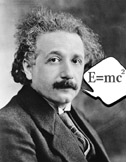
September 1905: Einstein's Most Famous Formula

Einstein

 Einstein's Most Famous Formula-

   physicsknow

Although several renowned scientists published papers bearing on the theory of special relativity prior to 1900 - including Maxwell, Lorentz and Henri Poincaré - 1905 is generally recognized as the birth year of special relativity. That year saw publication of two important papers on the subject, by an obscure patent clerk named Albert Einstein.
Having failed to obtain a university post teaching mathematics and physics, Einstein was working in the patent office in Bern, Switzerland, when he completed an astonishing range of theoretical physics publications, all written in his spare time with
out the benefit of close contact with scientific literature or colleagues.
In June, 1905, Einstein proposed what we know today as the special theory of relativity. He based his theory on a reinterpretation of the classical principle of relativity, which postulates that the laws of physics must have the same form in any frame of reference. The theory also assumed that the speed of light remained constant in all frames of reference, as required by Maxwell's theory.
But it was later that year, in a paper received by the Annalen der Physik on September 27, applying his equations to study the motion of a body, that Einstein showed that mass and energy were equivalent, a startling new insight he expressed in a simple formula that became synonymous with his name: E=mc2. However, full confirmation of his theory was slow in coming. It was not until 1933, in Paris, when Irène and Frédéric Joliot-Curie took a photograph showing the conversion of energy into mass, in which a quantum of light carries energy up from beneath and converts into mass in the middle, creating two particles which curve away from each other.

Monday, August 28, 2017

NASA say-Large Asteroid to Safely Pass Earth on Sept. 1 2017 - physicsknow

Large Asteroid to Safely Pass Earth on Sept. 1


Asteroid Florence, a large near-Earth asteroid, will pass safely by Earth on Sept. 1, 2017, at a distance of about 4.4 million miles, (7.0 million kilometers, or about 18 Earth-Moon distances). Florence is among the largest near-Earth asteroids that are several miles in size; measurements from NASA's Spitzer Space Telescope and NEOWISE mission indicate it’s about 2.7 miles (4.4 kilometers) in size.  
“While many known asteroids have passed by closer to Earth than Florence will on September 1, all of those were estimated to be smaller,” said Paul Chodas, manager of NASA’s Center for Near-Earth Object Studies (CNEOS) at the agency's Jet Propulsion Laboratory in Pasadena, California. “Florence is the largest asteroid to pass by our planet this close since the NASA program to detect and track near-Earth asteroids began.”
This relatively close encounter provides an opportunity for scientists to study this asteroid up close. Florence is expected to be an excellent target for ground-based radar observations. Radar imaging is planned at NASA's Goldstone Solar System Radar in California and at the National Science Foundation's Arecibo Observatory in Puerto Rico. The resulting radar images will show the real size of Florence and also could reveal surface details as small as about 30 feet (10 meters).
Asteroid Florence was discovered by Schelte "Bobby" Bus at Siding Spring Observatory in Australia in March 1981. It is named in honor of Florence Nightingale (1820-1910), the founder of modern nursing. The 2017 encounter is the closest by this asteroid since 1890 and the closest it will ever be until after 2500. Florence will brighten to ninth magnitude in late August and early September, when it will be visible in small telescopes for several nights as it moves through the constellations Piscis Austrinus, Capricornus, Aquarius and Delphinus. 
Radar has been used to observe hundreds of asteroids. When these small, natural remnants of the formation of the solar system pass relatively close to Earth, deep space radar is a powerful technique for studying their sizes, shapes, rotation, surface features and roughness, and for more precise determination of their orbital path.
JPL manages and operates NASA's Deep Space Network, including the Goldstone Solar System Radar, and hosts the Center for Near-Earth Object Studies for NASA's Near-Earth Object Observations Program, an element of the Planetary Defense Coordination Office within the agency's Science Mission Directorate.

Tuesday, August 22, 2017

A line that connects a planet to the sun sweeps out equal areas in equal times.-physicsknow

The Law of Areas-PhysicsKnow

The orbital radius and angular velocity of the planet in the elliptical orbit will vary. This is shown in the animation: the planet travels faster when closer to the sun, then slower when farther from the sun. Kepler's second law states that the blue sector has constant area.

Kepler-second-law
This is one of Kepler's laws.This empirical law discovered by Kepler arises from conservation of angular momentum. When the planet is closer to the sun, it moves faster, sweeping through a longer path in a given time. 

Developing Kepler's Law of Areas-PhysicsKnow

Law of Areas: Considering the area of an elliptical orbit, an infinitesemal area element can be expressed as
Integrating over r from the focus outward gives
So the time rate of change of the area swept out is
The velocity is in the plane of the ellipse and can be divided into radial and angular components:
Note that the angular component is proportional to the rate of change of area so that
Note that the radius r and the angular velocity are perpendicular to each other so that their product is equal to the magnitude of their vector product. But it was shown in the development of the Law of Orbits that this vector product is proportional to the angular momentum L.
It was also shown there that the angular momentum L is a constant, so that
establishes that the rate of change of area is a constant for all parts of the orbit, the Law of Areas.

Sunday, August 20, 2017

Solar eclipse of August 21, 2017-PhysicsKnow

Solar eclipse of August 21, 2017-PhysicsKnow


Solar eclipse of August 21, 2017-PhysicsKnow

On Monday, August 21, 2017, a total solar eclipse will be visible within a band across the entire contiguous United States. This eclipse will only be visible in other countries as a partial eclipse.
A solar eclipse occurs when the Moon passes between Earth and the Sun, thereby totally or partly obscuring the image of the sun for a viewer on Earth. A total solar eclipse occurs when the moon's apparent diameter is larger than the sun's, blocking all direct sunlight, turning day into darkness. Totality occurs in a narrow path across Earth's surface, with the partial solar eclipse visible over a surrounding region thousands of kilometers wide.
The last time a total solar eclipse was visible across the entire contiguous United States was during the June 8, 1918 eclipse, and not since the February 1979 eclipse has a total eclipse been visible from anywhere in the mainland United States. The path of totality will touch 14 states (although a partial eclipse will be visible in all fifty states),  and 16% of the area of the United States. The event will begin on the Oregon coast as a partial eclipse at 9:06 a.m. PDT on August 21, and will end later that day as a partial eclipse along the South Carolina coast at about 4:06 p.m. EDT.
There are expected to be logistical problems with the influx of visitors, especially for smaller communities.There have also been problems with counterfeit eclipse glasses being sold.
Future total solar eclipses will cross the United States in April 2024 (12 states) and August 2045 (10 states), and annular solar eclipses—meaning the apparent size of the Moon is smaller than that of the Sun—will occur in October 2023
 (9 states) and June 2048 (9 states).

Saturday, August 19, 2017

International Space Station astronauts to view the solar eclipse 3 times-PhysicsKnow

solar eclipse-PhysicsKnow
While millions of Americans gather across the country to catch a glimpse of Monday's total solar eclipse, the astronauts aboard the International Space Station will view the event from a much different vantage point.
The ISS crew members are predicted to view both a partial eclipse and the moon's shadow cast on the North American continent as they make three tracks around the planet 400 km above Earth's surface, according to NASA.
"Observing a total solar eclipse from manned spacecraft is difficult though not impossible," NASA reported.
NASA said the different rates of speed and intersecting paths are the main challenge to viewing an eclipse from space.
At minimum, ISS spends less than 15 seconds traversing the 100-km-wide lunar shadow even when the paths align in space and time, according to NASA. However, Earth’s horizon extends nearly 2,300 km from the ISS, allowing astronauts to see the lunar shadow if they are close enough during the event.
The total eclipse will begin on the Oregon coast at 17:15 UT (10:15 a.m. PDT) and will end along the South Carolina coast at 18:49 UT (2:49 p.m. EDT).
As the space station makes its first pass during the eclipse, the crew members will be able to view a partial solar eclipse with approximately 37 percent of the sun covered up, NASA reports.
However, at this point in time, the ISS will not be able to see the umbra, or the darkest part of the moon's shadow on the Earth's surface. The space station will pass over the western United States and southeastern Canada in the first pass. The total portion of the eclipse will not have started yet for the Earth.
As the station makes its second pass through the moon's shadow, the partial eclipse will be visible to the astronauts with 44 percent of the sun covered.
"ISS will witness the moon’s umbra moving from southwestern Kentucky to northern Tennessee during a portion of this pass," NASA reports.
"The moon’s umbra is visible on the Earth from ISS’s viewpoint while ISS traverses from southern Canada just north of the Montana-Canada border to the Gulf of Saint Lawrence."
At its closest approach, the space station will be making its way south of the Hudson Bay, far removed from the moon's umbra, which will be passing over southwestern Kentucky nearly 1,700 km away.
However, despite the distance, crew members aboard the ISS should still be able to view the shadow near the horizon.
The third pass for the ISS will bring another view of a partial solar eclipse with 85 percent coverage just minutes before orbital sunset. At this point, the darkest part of the lunar shadow will no longer be visible to crew as the umbra will have lifted from the Earth's surface as it makes its transit.
"Because of atmospheric friction and other ISS activities, the orbits undergo small changes from week to week," NASA reports.

The most precise timing will be available on NASA's ISS observations website.